
Fractions represent equal parts of a whole; the top number indicates slices possessed, while the bottom reveals the total equal slices.
Understanding these rules ensures simplified, accurate results, often expressed in their lowest terms, like 1/2, using a fraction calculator.
What are Fractions?
Fractions fundamentally represent parts of a whole, illustrating how many equal portions comprise a complete unit. Imagine a pizza sliced into equal pieces; a fraction describes how many of those slices you have. The core concept revolves around dividing something into equal parts, and a fraction quantifies that division.
They aren’t limited to physical objects like pizza, extending to abstract quantities and measurements. A fraction consists of two key components: the numerator and the denominator. Understanding this basic structure is crucial for grasping fraction rules. The denominator indicates the total number of equal parts, while the numerator shows how many of those parts are being considered.
Essentially, fractions provide a way to express quantities that fall between whole numbers, offering precision beyond simple counting. They are foundational in mathematics and appear frequently in everyday life, from cooking to construction.
Numerator and Denominator Explained
Every fraction possesses two essential parts: the numerator and the denominator. The denominator, located below the fraction bar, signifies the total number of equal parts that constitute the whole. It defines the size of each individual part. Think of it as the ‘whole’ being divided.
Conversely, the numerator, positioned above the fraction bar, indicates how many of those equal parts are being considered or selected. It represents the portion or quantity you have. Understanding their roles is key to applying fraction rules correctly.
For example, in the fraction 3/4, ‘4’ is the denominator, meaning the whole is divided into four equal parts, and ‘3’ is the numerator, indicating you have three of those parts. A fraction calculator often displays results with both numerator and denominator in their simplest form, achieved by dividing both by their greatest common factor.

Basic Fraction Operations
Fraction rules govern adding, subtracting, multiplying, and dividing. These operations require understanding common and differing denominators for accurate calculations and simplification.
Adding Fractions
Adding fractions requires a common denominator. When denominators are identical, simply add the numerators and keep the denominator constant. For instance, 1/5 + 2/5 = 3/5. However, if denominators differ, finding a common denominator is crucial. This involves determining the least common multiple (LCM) of the denominators.
Once a common denominator is established, convert each fraction accordingly. Then, add the numerators. Remember to always simplify the resulting fraction to its lowest terms by dividing both numerator and denominator by their greatest common factor (GCF). Online fraction calculators can assist with these calculations, providing results in both improper fraction and mixed number forms, always reduced to their simplest representation.
Fractions with Common Denominators
Adding or subtracting fractions possessing identical denominators is a straightforward process. Simply focus on the numerators – add or subtract them while maintaining the common denominator. For example, consider 2/7 + 3/7. The solution is (2+3)/7, which simplifies to 5/7. This principle applies equally to subtraction; 5/8 ⎻ 1/8 equals 4/8, which can then be reduced to 1/2.
The key is that the denominator already represents the ‘whole’ being divided into equal parts, so it remains unchanged. Utilizing a fraction calculator confirms these results, ensuring accuracy and presenting the answer in its lowest terms. This method streamlines calculations, making it a fundamental skill in mastering fraction rules.
Fractions with Different Denominators
When adding or subtracting fractions with unlike denominators, a preliminary step is crucial: finding a common denominator. This involves identifying the Least Common Multiple (LCM) of the denominators. For instance, to add 1/2 and 1/3, the LCM of 2 and 3 is 6. Convert each fraction to an equivalent fraction with the denominator of 6: 1/2 becomes 3/6, and 1/3 becomes 2/6.
Now, with a shared denominator, add the numerators: 3/6 + 2/6 = 5/6. The same principle applies to subtraction. A fraction calculator can assist in finding the LCM and performing these conversions, ensuring accuracy. Mastering this skill is essential for navigating more complex fraction rules and achieving simplified results.

Subtracting Fractions
Subtracting fractions follows principles similar to addition, but instead of combining, we determine the difference between two fractional quantities. The process diverges based on whether the fractions share a common denominator. If they do, simply subtract the numerators, keeping the denominator constant. For example, 5/8 ⎼ 2/8 = 3/8.
However, when denominators differ, finding a common denominator – typically the Least Common Multiple (LCM) – is paramount. Convert each fraction to its equivalent with this shared denominator before subtracting. A fraction calculator streamlines this process, especially with complex numbers. Remember to simplify the resulting fraction to its lowest terms for a concise answer, adhering to fundamental fraction rules.
When subtracting fractions that already share a common denominator, the process is remarkably straightforward. This shared denominator represents the equal parts the whole is divided into for both fractions. Consequently, you only need to focus on the numerators – the top numbers – which indicate how many of those parts you have.
Simply subtract the second numerator from the first, while keeping the common denominator unchanged. For instance, if you’re calculating 7/10 ⎼ 3/10, you subtract 3 from 7, resulting in 4/10. Always remember to simplify this final fraction to its lowest terms, if possible, using greatest common factor principles. A fraction calculator can quickly verify your work and ensure accuracy, reinforcing core fraction rules.
When adding or subtracting fractions possessing differing denominators, a preliminary step is crucial: finding a common denominator. This involves identifying a number that both original denominators divide into evenly. The least common denominator (LCD) is often the most efficient choice, minimizing complexity.
Once the LCD is determined, convert each fraction to an equivalent fraction with the LCD as the new denominator. This is achieved by multiplying both the numerator and denominator of each fraction by the appropriate factor. After conversion, you can proceed with adding or subtracting the numerators, keeping the common denominator intact. Remember to simplify the resulting fraction to its lowest terms, potentially utilizing a fraction calculator to confirm accuracy and reinforce these fundamental fraction rules.
Multiplying Fractions
Multiplying fractions is arguably the most straightforward operation. Unlike addition or subtraction, finding a common denominator isn’t necessary. To multiply two fractions, simply multiply the numerators together to obtain the new numerator, and multiply the denominators together to obtain the new denominator.
For example, (a/b) * (c/d) equals (ac)/(bd). The result is a new fraction. It’s crucial, however, to always simplify this resulting fraction to its lowest terms. This involves finding the greatest common factor (GCF) of the numerator and denominator and dividing both by it. A fraction calculator can be incredibly helpful in verifying your simplification and ensuring accuracy when applying these fraction rules. Remember to always present your answer in its simplest form.
Dividing Fractions
Dividing fractions might initially seem complex, but it’s easily mastered with a simple rule: “Keep, Change, Flip.” This means you keep the first fraction as it is, change the division sign to a multiplication sign, and flip (find the reciprocal of) the second fraction.
So, (a/b) ÷ (c/d) becomes (a/b) * (d/c), which then follows the rules for multiplying fractions – multiply the numerators and multiply the denominators. Again, simplification is key! Find the greatest common factor (GCF) of the resulting numerator and denominator and divide both by it to reduce the fraction to its lowest terms. Utilizing a fraction calculator can quickly confirm your calculations and ensure the final answer adheres to these fundamental fraction rules, presenting a clear and simplified result.

Simplifying Fractions
Simplifying fractions involves reducing them to their lowest terms by dividing both numerator and denominator by their greatest common factor (GCF).
This ensures clarity and efficiency when working with fraction rules.
Finding the Greatest Common Factor (GCF)
Determining the Greatest Common Factor (GCF) is crucial for simplifying fractions. The GCF is the largest number that divides evenly into both the numerator and denominator of a fraction. To find it, list the factors of each number – all the numbers that divide into it without a remainder.
For example, factors of 12 are 1, 2, 3, 4, 6, and 12. Factors of 18 are 1, 2, 3, 6, 9, and 18. The largest number appearing in both lists is 6, therefore the GCF of 12 and 18 is 6.
Alternatively, prime factorization can be used. Break down each number into its prime factors. Then, identify the common prime factors and multiply them together. This product is the GCF. Finding the GCF allows you to reduce fractions to their simplest form, adhering to core fraction rules.
Reducing Fractions to Lowest Terms
Reducing fractions to their lowest terms means expressing the fraction with the smallest possible whole numbers in the numerator and denominator while maintaining the same value. This is achieved by dividing both the numerator and denominator by their Greatest Common Factor (GCF), as previously determined.
For instance, if you have the fraction 12/18, and you’ve found the GCF to be 6, you divide both 12 and 18 by 6. This results in 2/3. The fraction 2/3 is now in its simplest form because 2 and 3 have no common factors other than 1.
Presenting fractions in their lowest terms is a fundamental aspect of following fraction rules. It simplifies calculations and provides a clearer representation of the fractional value, often aided by a fraction calculator for verification.
Types of Fractions
Fractions are categorized as proper (numerator < denominator), improper (numerator ≥ denominator), or mixed numbers (whole number + proper fraction), each following specific rules.
Proper Fractions
Proper fractions are fundamental in mathematics, representing a part of a whole where the numerator is less than the denominator. This signifies that the fraction’s value is always less than one. For example, 1/2, 3/4, and 2/5 are all proper fractions. They are easily visualized – imagine a pizza cut into four slices (denominator), and you have three slices (numerator).
Understanding proper fractions is crucial before tackling more complex fraction types. They form the basis for addition, subtraction, multiplication, and division of fractions. When working with proper fractions, remember that the denominator indicates the total number of equal parts, and the numerator shows how many of those parts are being considered. Simplifying proper fractions to their lowest terms is often necessary for clarity and accuracy, utilizing the greatest common factor (GCF).
Improper Fractions
Improper fractions differ from proper fractions as their numerator is greater than or equal to the denominator. This means the fraction represents a value equal to or greater than one whole unit. Examples include 5/4, 7/3, and 8/8. Visualize this as having more pizza slices than were originally in the whole pizza!
Improper fractions can be converted into mixed numbers – a whole number and a proper fraction combined – providing a more intuitive understanding of the quantity. Fraction calculators often present results in both improper fraction and mixed number forms. Working with improper fractions is essential for advanced mathematical operations. Remember that simplifying improper fractions, by dividing both numerator and denominator by their greatest common factor, is a key step towards presenting the fraction in its simplest form.
Mixed Numbers
Mixed numbers combine a whole number and a proper fraction, representing quantities greater than one. For instance, 1 ½ (one and one-half) signifies one whole unit plus half of another. They offer a more relatable way to express amounts compared to improper fractions, like 3/2, which represent the same value.
Converting between mixed numbers and improper fractions is a fundamental skill. A fraction calculator readily performs this conversion, displaying results in both formats. Understanding mixed numbers is crucial in real-world applications like cooking, measurement, and problem-solving. Simplifying the fractional part of a mixed number to its lowest terms is always recommended. Mastering mixed numbers builds a strong foundation for more complex fraction operations and ensures accurate calculations.

Converting Between Fraction Forms
Conversion between improper fractions and mixed numbers is essential; calculators efficiently handle this, presenting results in both formats, simplified to lowest terms.
Converting Improper Fractions to Mixed Numbers
Converting an improper fraction – where the numerator is larger than the denominator – to a mixed number involves division. Divide the numerator by the denominator. The quotient becomes the whole number part of the mixed number. The remainder then becomes the new numerator, keeping the original denominator.
For example, consider 7/3. Dividing 7 by 3 yields a quotient of 2 and a remainder of 1. Therefore, 7/3 converts to the mixed number 2 1/3. This process effectively separates the ‘whole’ portions from the fractional part.
Online fraction calculators automate this, displaying both improper fraction and mixed number forms, always reduced to their simplest terms by dividing by the greatest common factor. Mastering this conversion is crucial for understanding and manipulating fractions effectively.

Converting Mixed Numbers to Improper Fractions
To convert a mixed number – consisting of a whole number and a fraction – into an improper fraction, a simple multiplication and addition process is used. Multiply the whole number by the denominator of the fractional part. Then, add the numerator to this product. This new sum becomes the numerator of the improper fraction, while the original denominator remains unchanged.
For instance, let’s convert 2 1/3. Multiply 2 by 3, resulting in 6. Add 1 to 6, giving you 7. Therefore, 2 1/3 becomes 7/3. This method effectively combines the whole and fractional parts into a single fraction.
Fraction calculators readily perform this conversion, presenting results in improper form alongside mixed numbers, always simplified to lowest terms. Understanding this conversion is vital for performing operations like multiplication and division.
Fraction Calculators & Tools
Online tools simplify fraction operations – addition, subtraction, multiplication, and division – delivering results in lowest terms, and offering decimal conversions quickly.
Online Fraction Calculators for Addition, Subtraction, Multiplication, and Division
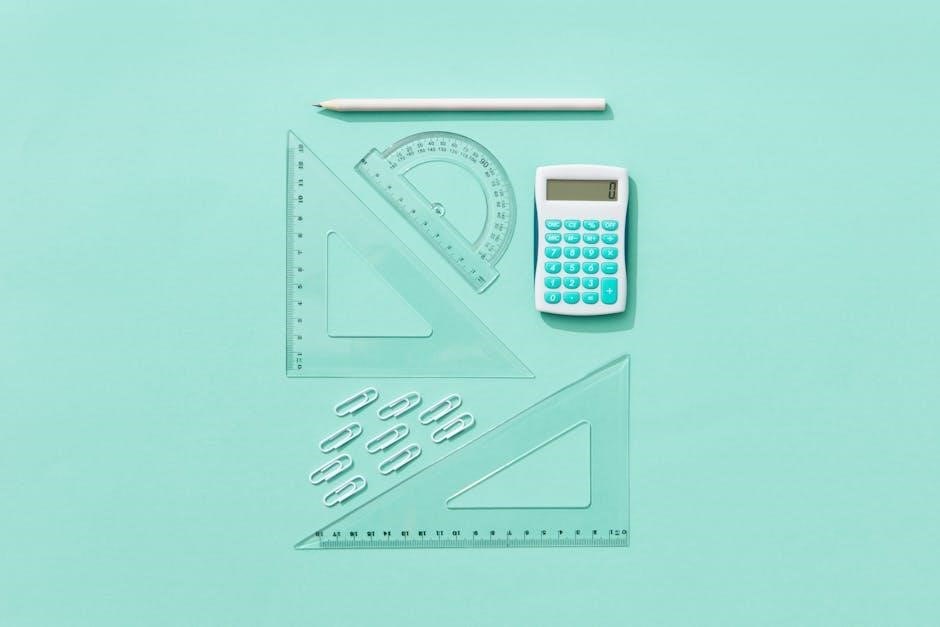
Fraction calculators provide instant solutions for all basic operations. Users input fractions and select the desired operation – addition, subtraction, multiplication, or division. These tools swiftly generate simplified results, expressed in their lowest terms by dividing both numerator and denominator by their greatest common factor.
These digital tools eliminate manual calculations, reducing the risk of errors and saving valuable time. They are particularly useful for checking homework, verifying calculations, or tackling complex problems. Many calculators also present answers in both improper fraction and mixed number formats, offering flexibility and clarity. Advanced calculators even include features like step-by-step solutions, helping users understand the underlying principles of fraction arithmetic. Utilizing these resources enhances comprehension and builds confidence in working with fractions.
Advanced Fraction to Decimal Converters
Advanced fraction to decimal converters go beyond simple conversion, offering precision and repeat detection. These tools expertly handle mixed numbers, allowing users to input complex fractional values. They display results with customizable precision, ensuring accuracy for various applications. A key feature is the ability to identify repeating decimals, representing them accurately with appropriate notation.
These converters often include clear formulas, aiding in understanding the conversion process. Visual aids, like plotting values, enhance comprehension and allow for easy comparison of outputs. Many platforms also offer downloadable reports, providing a record of calculations for future reference. These tools are invaluable for students, engineers, and anyone requiring precise fractional and decimal representations, streamlining complex mathematical tasks.

Real-World Applications of Fractions
Fractions are essential in daily life, notably in cooking and measurement, ensuring precise ingredient ratios and accurate dimensions for various tasks.
Fractions in Cooking and Baking
Cooking and baking heavily rely on precise measurements, making fractions indispensable. Recipes often call for ingredients like 1/2 cup of flour, 3/4 teaspoon of salt, or 1/3 cup of sugar. Understanding fraction rules is crucial for accurately following these instructions and achieving the desired results.
Incorrectly measuring ingredients due to a misunderstanding of fractions can significantly impact the final product’s texture, taste, and overall quality. For example, doubling a recipe requires multiplying all fractional ingredients, while halving a recipe involves dividing them.
Successfully navigating these adjustments necessitates a firm grasp of fraction addition, subtraction, multiplication, and division. Utilizing a fraction calculator can be helpful, but comprehending the underlying principles ensures consistent and reliable outcomes in the kitchen. Mastering fractions transforms baking from guesswork into a precise and rewarding skill.
Fractions in Measurement
Fractions are fundamental in various measurement systems, extending beyond cooking to carpentry, construction, and everyday tasks. When measuring length, width, or height, we frequently encounter fractional inches, feet, or meters – like 1/4 inch, 2 1/2 feet, or 0.75 meters.
Accurate measurements are vital for projects requiring precision. For instance, in woodworking, a slight miscalculation involving fractions can lead to ill-fitting joints or structural instability. Similarly, in tailoring, precise fractional measurements ensure garments fit correctly.
Understanding how to add, subtract, and convert fractions is essential for interpreting measuring tapes, rulers, and other measuring tools. A fraction calculator can assist with complex calculations, but a solid understanding of the underlying principles is crucial for practical application. Correctly applying fraction rules guarantees accuracy and successful project completion.